


What Happens When Chinese Cars Start Filling Up UK Workshops?
 16.09.2026
 6 mins to read
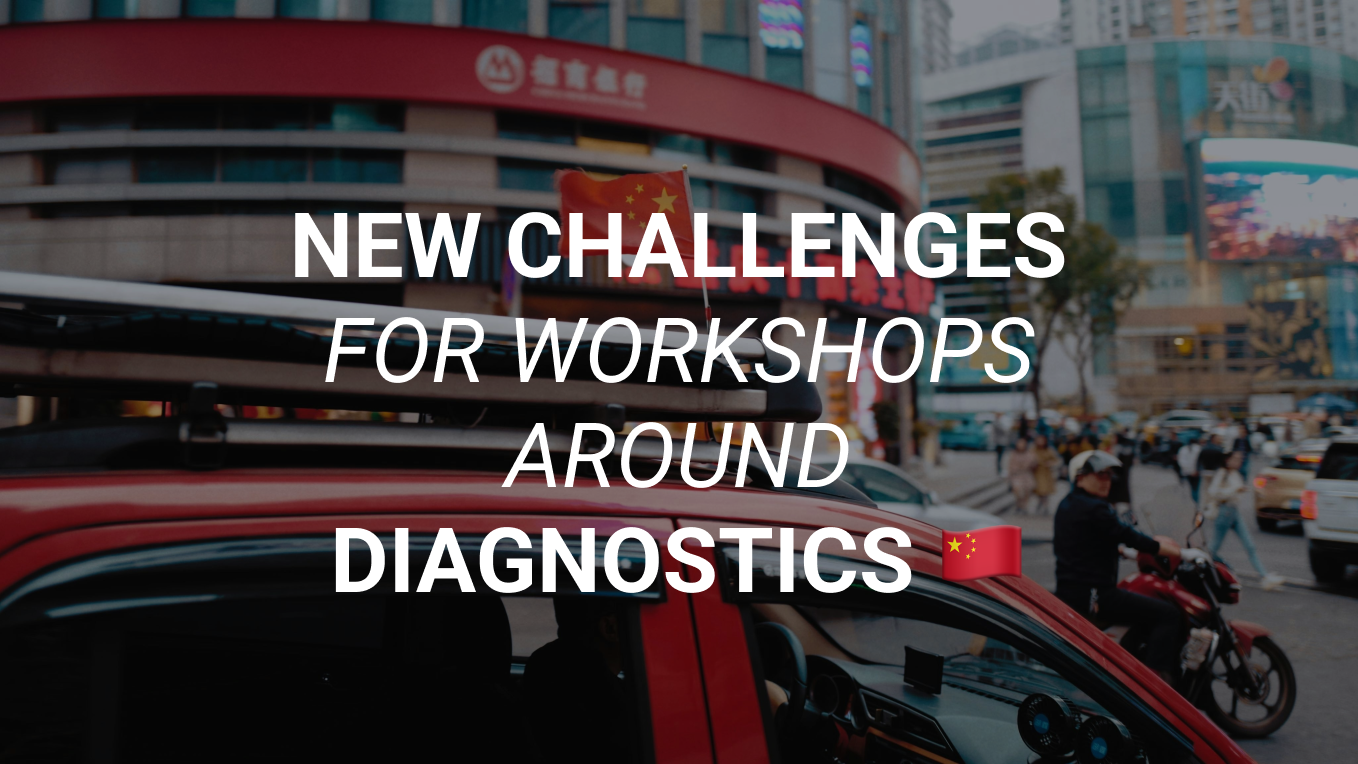
A car rolls onto the ramp. Nobody has seen the badge before. The diagnostic tool does not recognise half the control units. The parts catalogue comes back blank.
Sounds far-fetched. It is not, not anymore. Chinese electricbrands accounted for 15% of UK new car registrations in 2026, and workshops are already catching up on what that means for diagnostics, training and parts.
Here is what changes for the people fixing these cars, and the people hiring them.
Parts: the wait that eats the margin for cars in the UK
Most Chinese brands still run parts on a ‘pull’ model. Ordered from source once a job is confirmed, not stocked in regional warehouses ahead of demand the way most European brands do. A component that would sit in a UK depot for a Ford or a VW often has to be shipped in for a BYD or a Chery. That difference shows up not just on the invoice but directly in Chinese electric vehicle courtesy car costs and cycle time.
The gap is closing, but not evenly. BYD and MG’s UK dealer networks now run over 150 and 130 sites respectively, which helps stock density for the biggest sellers. Smaller or newer badges (Omoda, Jaecoo, Leapmotor, GWM) do not have that depth yet, and a bodyshop working across several Chinese brands can be running five different supply chains with five different lead times on the same day.
If your estimators are still quoting parts lead times off habit rather than checking per brand, that’s where the margin is quietly leaking.
Diagnostics is where this actually bites for Chinese cars
Not the metalwork. The electronics.
Decades of technician expertise rest on legacy control units, network architectures and diagnostic protocols. Chinese platforms run a different set of all three, and that gap hits hardest at the diagnostic bay, before a technician even opens the bonnet. Get the tool wrong, and the job does not start.
Roughly how the two worlds compare for an independent workshop right now:
| Area | Legacy brands | Chinese brands (BYD, MG, Chery, GWM etc.) |
| Diagnostic tool coverage | Mature, widely supported | Patchy, still being reverse-engineered |
| Technician familiarity | Decades of exposure | Little to none for most existing staff |
| Software update process | Standardised, dealer and independent access | Varies by brand, often OTA, less transparent |
| ADAS calibration data | Documented via Thatcham and manufacturer channels | Inconsistent, growing but not standardised |
Every row on that table points in the same direction: Chinese cars are not harder to fix. But the tools, the data and the people who know how to use them have not kept pace with how quickly these cars are arriving on the ramp.
Chinese brands lean harder on over-the-air updates than most legacy makers. A Chinese EV can change behaviour overnight, with no dealer visit and no paper trail for your workshop to check against.
Training has not caught up, and the gap is measurable for electric vehicles
You can blame China all you like, but the Chinese wave did not create this problem. It just made it impossible to ignore.
According to the IMI’s latest EV TechSafe Technician Forecast, only 35% of UK technicians currently hold an EV qualification, with new certifications down 17% year-on-year despite rising demand. Pro-Tech MOT & Automotive Academy sees the same gap from the training floor: qualifications aren’t even the real barrier. Many experienced technicians spent decades being trained to treat high-voltage systems as dangerous, and moving into EV work takes hands-on exposure and repeated practice, not just a certificate. That hesitation costs real time on the ramp, and on a high-voltage platform, hesitation is exactly what insurers price into the job.
What happens next is simple. The workshops that invest in that hands-on exposure now will be the ones customers, insurers and fleets trust with these cars. The ones that do not will keep turning work away, and lose the technicians willing to learn to whoever trains them first.
Data access: the door is opening, but not for everyone yet
The Security-related Repair and Maintenance Information (SERMI) scheme went live in the UK on 1 April 2026, giving accredited independent garages legitimate access to security functions that were previously locked behind manufacturer-specific firewalls and expensive dealer-only subscriptions:
- Key programming
- Immobiliser coding and resets
- ECU software updates
- Anti-theft and security module access
Before SERMI, getting this kind of access meant applying separately to every manufacturer, with its own credentials, its own vetting process and its own cost. SERMI replaces that with one accreditation that works across every participating brand. For a workshop juggling five or six badges on the same day, that’s the difference between one login and six.
It launched with 22 manufacturers already signed up: Ford, Jaguar Land Rover, Toyota, Nissan, the wider Stellantis group (Vauxhall, Peugeot, Citroën, Fiat, Jeep) and, shortly after launch, Mercedes-Benz. Not one of them is a Chinese brand.
The scheme is voluntary in the UK, not mandated by law, so nothing is stopping a Chinese manufacturer from joining. None have, and none have said when or if they will.
So as Chinese-brand volume keeps growing, the access gap widens. Every workshop fixing these cars today does it without the standardised route every other major brand has already signed up to.
So, what actually happens as Chinese EVs reshape the UK car market?
Parts delivery gets slower before it speeds up. Diagnostics stays patchy until tool coverage catches up. Training and data access stay a step behind the badges already on the road. None of that changes overnight, and none of it changes on its own.
This splits the workshop floor into two groups. Technicians who go and get hands-on with these platforms become harder to replace, not easier. Bodyshops and ARCs that build that capability now become the ones insurers, fleets and franchise networks call first when this work lands, and everyone else spends 2027 fighting for the same small pool of people who already know what they are doing.
If you are on the tools and want to be in the first group, see the roles Meenz has open https://meenz.co.uk/jobs/.
If you are staffing for what is coming and not just what already happened, talk to Meenz about your next hire.
Sources:
https://www.payment-assist.co.uk/blog/is-your-garage-ready-for-chinese-car-repairs
https://go-e.com/en/magazine/chinese-electric-cars
https://www.actronics.co.uk/news/how-chinese-cars-are-changing-the-uk-aftermarket
https://www.theimi.org.uk/industry-latest/research/ev-techsafe-technician-forecast-q4-2025