


Static vs Dynamic ADAS Calibration: What Each One Really Costs Your Bodyshop in Capacity
 29.10.2026
 6 mins to read
Your team finished a customer’s car this morning. The customer is calling, but the car cannot leave until its ADAS calibration is done.
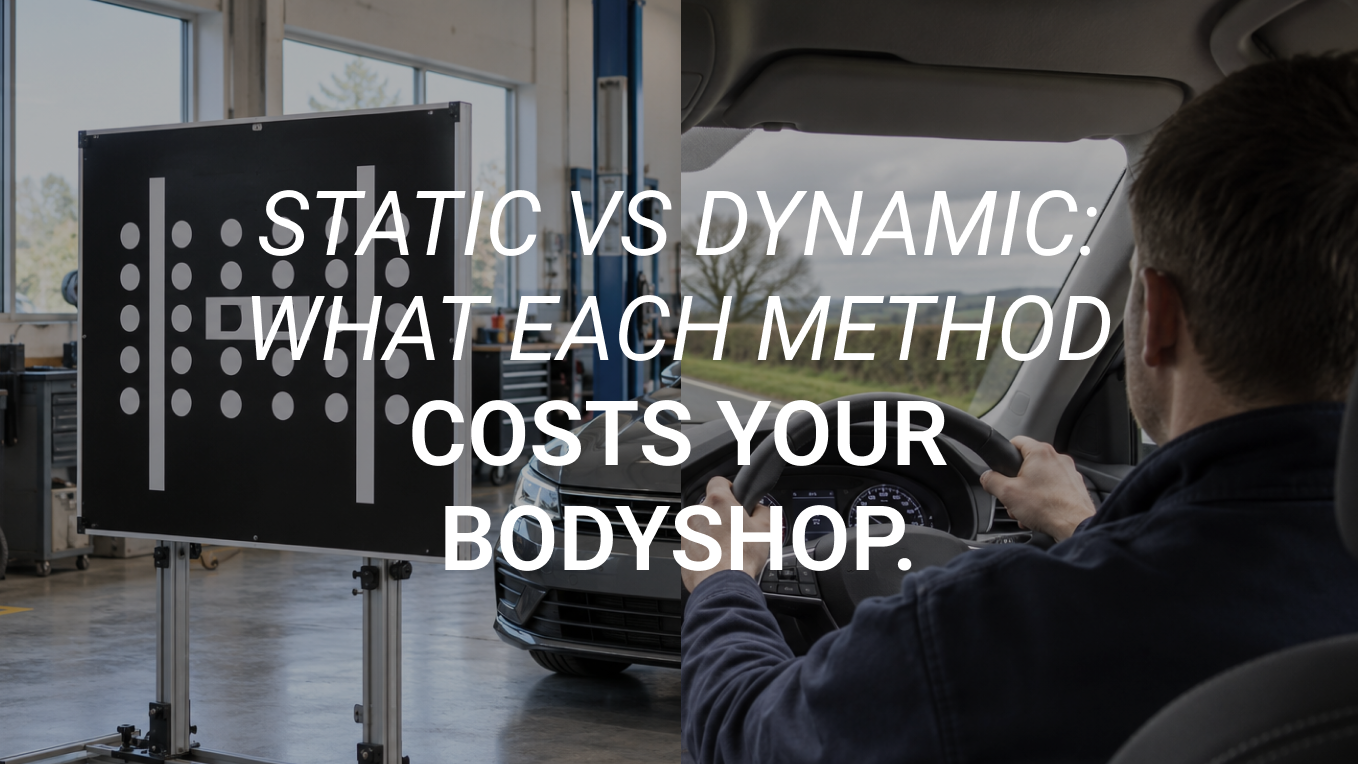
Every hour it waits, it blocks space and holds up the next job. The manufacturer’s method determines what it needs: static needs a free bay; dynamic needs a dry road and an off-site technician. Some cars need both.
Who decides the method? What does a static bay take? What does a dynamic drive cost? How long does the whole job really run?
Here is what the answers mean for your workshop.
The manufacturer picks the ADAS calibration method
The vehicle maker’s procedure sets the method for the exact model, year, trim and sensor. A growing share of vehicles need both methods, almost always static first.
Toyota, Hyundai and Kia are commonly dynamic. Some Volvo, Land Rover and Vauxhall models often need both. Treat that as a starting guess for the cars on your ramp.
The exact method depends on the VIN, the ADAS package and any technical service bulletins. Make the VIN lookup the first step on every ADAS job. It shows whether the car needs a bay, a road or both, and each one costs something different.
Static calibration takes a bay out of production
When the VIN says static, the car needs a bay that does nothing else while it runs. A UK calibration provider lists the demands for front-camera work:
- Floor: flat and level, with no slopes or drains
- Space: a clear, straight area of 6 to 8 metres in front of the car and 2 to 3 metres around it
- Light: steady and glare-free, with minimal reflections
- Car: normal ride height and correctly inflated tyres
Targets go up on stands at distances the maker specifies, and the car must be squared to them before the scan starts. Multi-camera, radar, or lidar setups, bumper repairs, strict OEM light control, or tight space push the job into a controlled bay.
Dynamic ADAS calibration takes your technician and the car out of the building
Dynamic calibration is a road drive at set speeds on clear, well-marked roads. The speed is not the shop’s call. Manufacturers set the on-road criteria, such as sustained speeds, clear lane markings and visible signs, and a provider signs off only when the maker’s thresholds are met. A route that suits one car can fail on the next.
Miss a condition, and the routine fails. Faded markings, low sun glare, heavy rain or a blocked camera view are the usual causes. The job is then rebooked.
Dynamic calibration takes a planned route, a good weather window and a technician you can spare.
Wheel alignment can add a second booking
Static work aims the camera at the car’s thrust line. The sensors detect the direction the car travels, so they must be aligned with the vehicle to read correctly. Wheel alignment issues rule out mobile work and call for a controlled bay. A wheel alignment adjustment is itself a trigger for recalibration.
That is a ramp or rack slot you also have to book.
Static vs dynamic ADAS calibration: the clock runs longer than the calibration
One UK provider quotes these timings:
| Method | Quoted time | What it ties up |
| Static | 30 to 90 minutes | Bay, rig, level floor |
| Dynamic | 30 to 60 minutes or more | Technician, car, road |
| Both | 1.5 to 3 hours | All of it, in sequence |
Around the calibration sit a pre-scan, a post-scan and a short test drive. The car must arrive ready: clean windscreen, correct tyre pressures, no heavy boot load, fuel in the tank. At the top of the range, a dual-method car takes three hours, even before the scans, test drive, and prep.
Calibration explained: why a calibration that passes can still be wrong
The costliest time is the time you pay twice. A system out of aim can look fine: many modules pass a basic self-check, so no warning light appears, and nothing on the outside of the car shows it.
Dual-method cars add a second trap. If weather blocks the drive, the static work is done, and the job waits for another visit. A redo costs bay time, driver time and a delivery date.
ADAS work carries real liability. Under the UK insurers’ requirements published by Thatcham Research, a repairer must record whether ADAS is present, complete the calibration the repair procedure calls for, and show the results sit within the maker’s specification. A badly aimed system can also lengthen stopping distances and delay the car’s interventions.
Insurers increasingly ask for proof, so keep records: pre- and post-scan reports, the method used and the results, and photos of key steps.
One bay and one technician fit three to five static and dynamic ADAS calibration jobs a day
Demand keeps climbing. Auto Windscreens reports that its ADAS calibrations rose 30% in 12 months, and that more than 40% of its front windscreen replacements now include one.
One bay and one technician running both-method jobs at 1.5 to 3 hours each fit about three to five in an eight-hour shift, before alignment and paperwork. That is our own arithmetic.
Mobile providers can take the overflow for front-camera jobs. Ask which of your cars they can calibrate on site and which they would send to a bay. That split decides how much work stays with you.
The bottleneck you cannot buy is a person
The IMI counts 10,695 ADAS-qualified technicians in the UK, around 3% of the technician workforce, and expects about 2,421 new certifications in 2026. Its forecast shows demand growing much faster than qualifications over the next decade.
A Thatcham Research survey with CEBR found that 73% of UK repair and salvage professionals see the widening skills gap as a growing challenge.
One name on the rota is a risk. If that person is off sick, calibrations stop, and every booked job waits.
Your last 90 days of collision repair orders show where the gap is
Take the last 90 days of repair orders and tag every ADAS job static, dynamic or both. Then add up bay hours, driving hours and hours per technician.
Bay hours piling up mean a floor decision. Driving hours piling up mean a route decision. Hours stacking on one name mean a hiring decision.
Equipment adds capacity only on the days someone qualified is there to run it. Count that person before you buy the next rig.
If one name on your rota is holding up the bay, brief Meenz on the role. We recruit for exactly this gap.
Sources:
https://adasdiagnostictools.com/resources/static-vs-dynamic-calibration/
https://www.fleetmotorglass.co.uk/static-vs-dynamic-adas-calibration-2026/
https://www.fleetmotorglass.co.uk/adas-calibration-mobile-vs-workshop/
https://www.fleetmotorglass.co.uk/static-vs-dynamic-adas-calibration-windscreen-replacement/
https://www.fleetmotorglass.co.uk/adas-calibration-myths-debunked-after-new-windscreen/
https://hella.com/partnerworld/assets/documents/Thatcham-IIR-Requirements-March-2020-v2.pdf
https://www.fleetnews.co.uk/news/increase-in-adas-calibrations-for-auto-windscreens
https://tide.theimi.org.uk/industry-latest/research/adas-techsafe-technician-forecast-q4-2025