


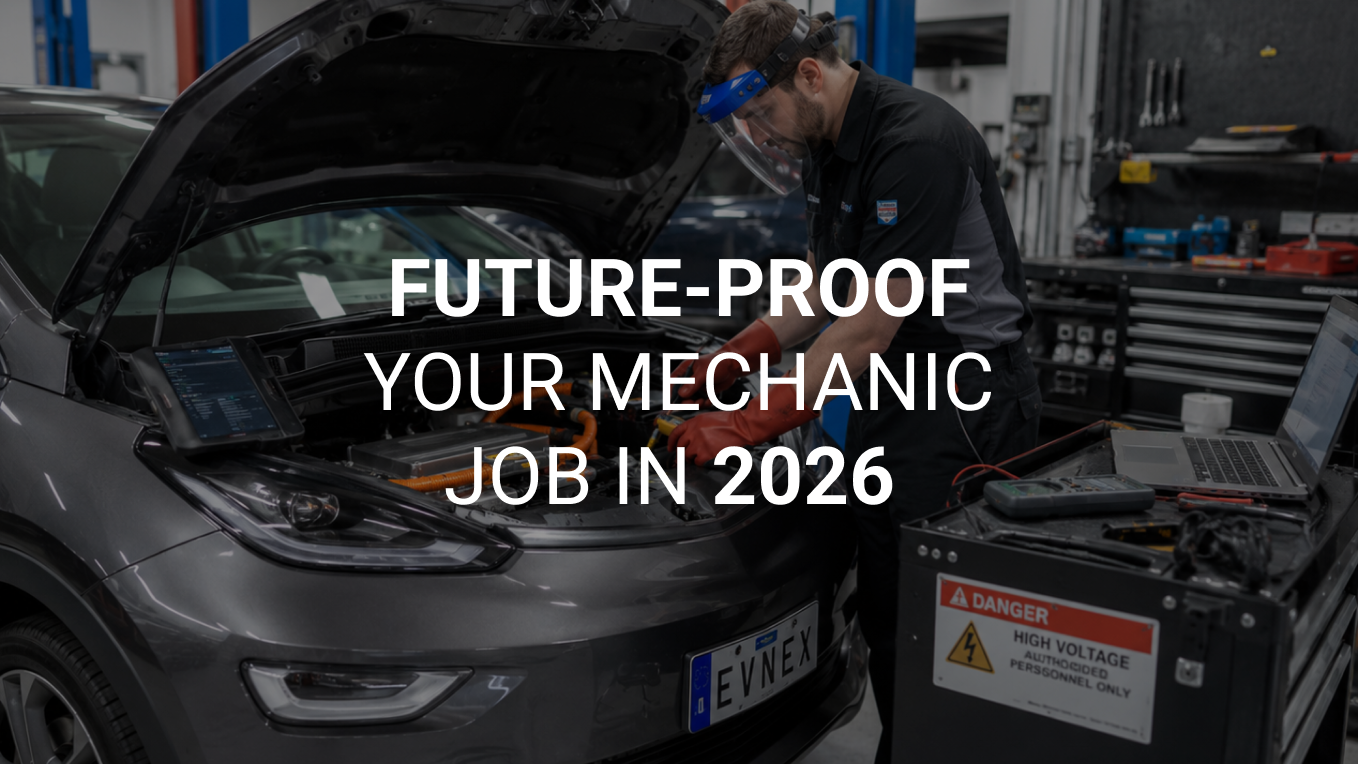
Future-Proof Your Mechanic Job in 2026: The Skills Every Car Mechanic Needs in the Automotive Industry
 11.06.2026
 5 mins to read
Three percent of UK technicians are currently qualified to work on ADAS systems. The vehicles requiring that qualification are already on your ramp. That gap is your staffing problem, not a future one.
Why every car mechanic needs to future-proof their career now
Electrification is not the story. We all know it is moving at pace. Less talked about is that only one in four UK technicians is currently qualified to work on electric vehicles. The vehicles are outpacing the workforce, and the gap is not closing.
The IMI TechSafe data from early 2026 shows the number of technicians gaining EV qualifications actually dropped by 13% between Q1 and Q3 of 2025. The UK faces a projected shortfall of 44,000 EV-trained mechanics by 2035. ADAS is an even sharper problem, as just 3% of UK technicians are currently qualified to work on advanced driver assistance systems, against a projected need of 97,000 by 2032.
The market is not waiting for the workforce to catch up. That is either a problem or an opportunity, depending entirely on what you do next.
EV and ICE competency are both required. That is the hard part IN automotive career.
There are 34 million cars on UK roads, and only 5.8% are fully electric. Petrol and diesel are not leaving your workshop anytime soon. But EVs and hybrids are a growing share of every working day, and that share is only moving in one direction.
The staffing problem is not EV versus ICE. It is finding technicians who can handle both. Half-competence in either direction is not enough, and the window to build that depth in your team is narrowing.
What the mechanic job actually looks like in 2030
This is already happening in better-equipped workshops today. By 2030, it will be the norm everywhere. A diesel estate is for a service. A hybrid SUV with a fault code spanning both the ICE and electric drivetrain. A fully electric hatchback needing post-repair ADAS calibration after a front-end bump. A petrol van whose forward-facing camera was disturbed during a windscreen replacement.
Four vehicles. Four different sets of demands. All on the same ramp, on the same day.
The technician who can move confidently across all four is the one every workshop manager will be trying to hold onto. The one who cannot will find themselves limited to a shrinking slice of the work coming through the door.
The technician skills that will define the transition
Mechanical knowledge gets you through the door. What happens next depends on what you added to it. When you are evaluating a technician’s CV or deciding who to retain, these are the skills that separate a productive hire from an expensive gap:
- High-voltage system safety: working on 400V to 800V battery systems requires specific training and certification. Without IMI Level 2 or Level 3 EV qualifications, a technician cannot legally or safely work on these vehicles in most UK workshops;
- Battery diagnostics and thermal management: identifying faults in battery packs, managing charging cycles, and understanding degradation are core skills on any EV job, not specialist knowledge reserved for franchise dealers;
- ADAS calibration: lane assist, adaptive cruise control, blind spot radar and parking sensors all require precise calibration after any repair that disturbs sensors or cameras. This applies to EVs and ICE vehicles alike;
- Software-based fault finding: modern vehicles communicate through ECUs and proprietary software. Interpreting diagnostic data accurately is now as important as any physical inspection;
- OTA update awareness: over-the-air updates can change vehicle parameters after a repair. Technicians who do not account for the vehicle’s software state at handover create problems that come back.
What training to fund and what it actually costs in motor industry
The pathway from ICE to full EV competency is shorter than most technicians expect. The table below shows the key qualifications, what they cover and how long they take:
| Qualification | What It Covers | Typical Duration |
| IMI Level 2 EV | Safe working around hybrid and electric vehicles | 1 day |
| IMI Level 3 EV | Diagnosis and repair of EV and hybrid systems | 3 to 5 days |
| IMI ADAS Calibration | Static and dynamic calibration of driver assistance systems | 1 to 2 days |
| Skills Bootcamp | Broader EV and diagnostics upskilling for existing technicians | 6 to 16 weeks |
The IMI TechSafe register is publicly searchable by consumers and fleet operators, meaning certification is not just a compliance exercise. It is a visible signal of competence to every employer who looks up a potential employee.
Skills Bootcamps are funded through the UK Government’s lifetime skills guarantee. For most eligible technicians, the cost to an employer is minimal. The real cost is bay time. That calculation is worth running now, because the technicians who will be hardest to find in 2030 are the ones nobody invested in in 2026. Every month of delay is a month of ground given up to someone who started earlier.
Your 2030 staffing problem is a 2026 hiring decision – future of automotive
Meenz works exclusively in collision repair and vehicle technician staffing across the UK. If you are trying to build a workshop team that can handle what is coming through the door in 2030, and you are struggling to find technicians with the right mix of EV, ADAS and mechanical competency, that is exactly what we do. Talk to us before the gap becomes a problem you are managing reactively.
Sources:
https://www.perfectplacement.co.uk/blog/view/592/electric-vehicle-technician-training
https://www.autotrainingcentre.com/blog/in-demand-auto-technician-skills-2026/
https://www.rac.co.uk/drive/electric-cars/choosing/electric-car-statistics-and-data
https://www.zapmap.com/ev-stats/ev-market
https://www.am-online.com/news/autotech-training-warns-of-widespread-skills-gap-in-adas-calibration
https://bmmagazine.co.uk/news/uk-ev-mechanics-shortage-automotive-transition