


Reskilling in Automotive: Which Workforce Roles Will Still Matter in 2026?
 13.05.2026
 6 mins to read

In 2026, the question is not whether the automotive sector is changing. It is whether the people in your workshop are changing with it.
Some roles are becoming significantly more valuable. Others are being compressed, automated, or made redundant entirely. The technicians who have not moved with the shift are finding that years of experience no longer guarantee them a place in a modern bodyshop.
This article covers which roles are under the most pressure, which are gaining value, whether reskilling is realistic for everyone, and what it means for your hiring decisions right now.
The automotive roles under the most pressure caused by electrification
Not every role in collision repair is equally exposed. The ones under the most pressure share a common characteristic: they rely heavily on mechanical knowledge that does not transfer directly to electric or hybrid vehicle repair.
In 2026, the roles facing the sharpest decline in demand or the most significant skills displacement are:
- General mechanics without EV certification, where the shift to electric drivetrains has made traditional engine knowledge increasingly redundant in workshops handling modern vehicles.
- Estimators using legacy systems, where AI-assisted damage assessment tools are compressing the time and specialist knowledge previously required to produce an accurate repair estimate.
- Vehicle preppers with no ADAS awareness, where preparation work on modern vehicles increasingly requires an understanding of sensor placement and calibration requirements that go beyond traditional prep skills.
- MET technicians without hybrid or EV training, where mechanical, electrical, and trim work on electric vehicles requires different safety protocols and component knowledge than petrol or diesel equivalents.
The roles gaining value & workforce trends in 2026
On the other side of the same shift, a smaller set of roles is becoming significantly more valuable. Demand is outpacing supply, and the gap is widening.
The demand for EV-capable roles across the automotive sector is outpacing the training pipeline’s ability to produce qualified candidates.
Can everyone reskill in the automotive industry?
The honest answer is no. Not everyone can make the transition, and not every employer is set up to support it.
Reskilling in automotive requires more than attending a course. It requires the willingness to approach familiar work differently, the aptitude to learn new diagnostic and technical processes, and the time to apply that learning in a real workshop environment before it becomes useful.
The UK Government’s lifetime skills guarantee provides funding routes for adult reskilling through approved providers, including automotive technical courses. The routes exist. The barrier is rarely the cost. It is time, workplace culture, and whether the operator is willing to release a productive technician from the bay long enough to develop.
The technicians who adapt successfully tend to share a common profile: they are already technically curious, have sought out new knowledge without being told to, and have access to a workshop environment that exposes them to modern vehicles. The ones who do not adapt are often in workshops that have not yet had to change, where the pressure to reskill has not yet arrived. When it does, the gap will be significant.
Most bodyshops are leaving reskilling to the individual
Most bodyshops are not actively investing in reskilling. The reasons are consistent: time, cost, and the difficulty of releasing a productive technician for training without affecting throughput.
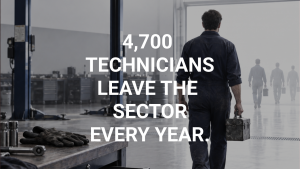
The result is that reskilling in the UK automotive sector is largely happening at the individual level rather than the employer level. Technicians who want to stay relevant are pursuing IMI TechSafe accreditation and EV certifications on their own initiative. The IMI’s July 2025 forecast confirms that just 28% of the UK technician workforce is currently EV qualified, with progress still lagging behind future demand. The ones who are not doing that are falling behind, often without realising it.
Only 34% of UK employers have a structured plan for reskilling employees in response to technological change. In automotive, that figure is likely lower. Operators who are actively investing in their team’s technical development are creating a retention advantage as well as a capability advantage.
What this means for your hiring decisions
The reskilling gap has a direct consequence for operators trying to hire in 2026. The pool of candidates with the certifications you need is small. The pool of candidates who are willing and able to develop those certifications with the right employer support is larger, but requires a more considered hiring approach.
Hiring someone with traditional skills and a demonstrable appetite for development is a viable strategy if the workshop environment supports it. Hiring someone with traditional skills and no plan for their development is how you end up with a team that is increasingly mismatched to the vehicles coming through the door.
The collision repair roles that are hardest to fill right now are the ones where reskilling has already happened, and the candidate knows their value. Panel beaters with EV awareness, paint sprayers with ADAS calibration knowledge, damage assessors with electric vehicle certification. These candidates exist. The challenge is that they are already placed, and they did not get there by responding to an advert.
Increasing demand looking for the right employee?
If your workforce planning in 2026 depends on finding people who have already made the transition, contact the Meenz team directly to discuss your vacancy. We work exclusively in collision repair staffing across the UK and can identify the right candidates without you having to wait for them to come to you.
Sources:
https://tide.theimi.org.uk/industry-latest/research/automotive-labour-market-briefing-march-2026
https://www.bodyshopmag.com/2025/news/imi-techsafe-vital-for-consumer-confidence-in-adas
https://www.smmt.co.uk/uk-auto-apprenticeships-surge-as-sector-builds-next-gen-workforce/
https://www.gov.uk/guidance/free-courses-for-jobs
https://tide.theimi.org.uk/industry-latest/research/ev-techsafe-technician-forecast-july-2025
https://www.cipd.org/en/knowledge/factsheets/learning-methods-factsheet